

Why Paper and Spreadsheets Are Killing Your Athlete Development Programs (And What to Use Instead)
Every sports coach starts with good intentions. You want to track how your athletes are progressing. You want to know who is ready to move to the next level, who needs more time with a skill, and whether your programs are actually working. So you pull out a paper form or open a spreadsheet, and you start tracking.
For a while, it works. Then it does not.
Paper forms get wet at the poolside. Spreadsheets get saved to someone’s personal laptop. A coach leaves mid-season and takes all their notes with them. A parent asks how their child is doing and you have to dig through files to find an answer. By the time the season ends, you have data that tells you almost nothing useful because getting meaning out of it would take longer than the off-season.
This is not a small problem. It is one of the most common reasons sports clubs struggle to improve their programs year over year. And it has a straightforward fix.
Why Paper Was Never a Real Solution
Paper has one thing going for it: it is familiar. Coaches know how to fill out a form. There is no login, no learning curve, no technology to break at the wrong moment.
But familiar is not the same as effective.
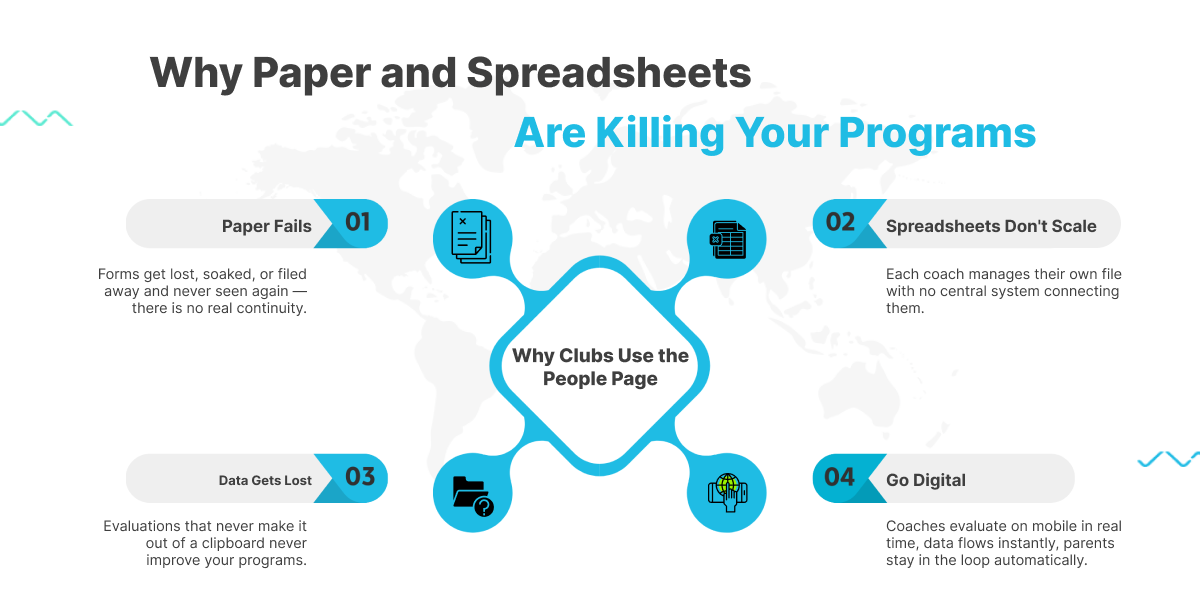
When you track athlete evaluations on paper, every single piece of data lives in a physical form that can be lost, damaged, or simply forgotten. Filing cabinets are not searchable. You cannot look up how a particular athlete performed two seasons ago without physically locating the right folder and flipping through pages. You cannot pull a report on how many athletes completed a specific skill level across your whole program. You cannot share progress with parents without printing something and handing it over in person.
Paper also creates a serious continuity problem. When a coach moves on, their paper records often go with them or get filed somewhere no one remembers. The next coach starts from scratch. Athletes who have been part of your program for years have their development history effectively reset because there is no centralized record of it.
The cost of this is hard to see at the moment but adds up significantly over time. Every season you spend rebuilding what was lost is a season you are not improving.
Why Spreadsheets Are Not Much Better
Spreadsheets feel like an upgrade from paper because they are digital. Data is stored on a computer, it can be searched, and you can do some basic calculations. For a very small club with one coach and a handful of athletes, a spreadsheet might be enough to get by.
But most sports clubs are not that small. And even the ones that are will eventually grow.
The problems with spreadsheets show up quickly when you start to scale. Each coach is typically managing their own file. There is no central system connecting them. When an administrator wants to see how all athletes across all programs are progressing, they have to collect files from every coach, combine them manually, and then try to make sense of inconsistent formatting and missing entries.
That process is slow. It is also error-prone. And it assumes that every coach is actually maintaining their spreadsheet consistently, which is rarely the case in practice.
Spreadsheets also do not talk to anything else. They do not connect to your registration system. They do not send progress updates to parents. They do not generate reports automatically. Every piece of useful information has to be extracted manually by someone who already has too much to do.
Checklick was built specifically because this gap existed. Coaches needed a way to track athlete progress that was as easy as filling out a form but actually connected to the rest of the club’s operations. That is what a purpose-built athlete development platform does that a spreadsheet simply cannot.
What Gets Lost When You Track Manually
The most damaging effect of paper and spreadsheet tracking is not the time it wastes, though it wastes plenty. It is the data that never gets captured or never makes it to the people who need it.
Think about what happens when a coach evaluates an athlete on paper during a session. That evaluation lives on that sheet of paper until the coach does something with it. If they are busy, it sits on a clipboard for a week. If they forget, it gets filed without ever being reviewed. If the data would have changed how the program was designed next season, no one ever finds out.
With a digital system like Checklick, the moment a coach evaluates an athlete on their phone or tablet, that data is instantly available to administrators. There is no delay, no risk of losing it, and no manual step required to get it from the field into the hands of the people making program decisions. Parents can also be kept in the loop automatically, receiving progress updates that show exactly how their child is developing without anyone having to manually compile a report.
This matters enormously for clubs that are trying to demonstrate the value of their programs to funders, parents, and governing bodies. When you can show real data on athlete progression, you are not just talking about quality. You are proving it.
The Problem Multiplies at Scale
For a club running one program with one coach and twenty athletes, manual tracking is painful but survivable. For a club running multiple programs across multiple coaches, or a national organization deploying programs to dozens of training centers, it becomes completely unmanageable.
Imagine trying to understand program performance across twenty training centers, each with ten coaches, each evaluating ten athletes. That is two thousand individual evaluations to collect, organize, and analyze. With paper, that is a filing nightmare. With spreadsheets, that is weeks of manual work every time you want a meaningful answer.
An online Athlete Development Tracking System changes that equation entirely. When evaluations are entered digitally by coaches in the field, they flow up through the system automatically. An administrator at the top of that chain can see aggregate data across every training center, every coach, and every athlete without waiting for anyone to submit anything. The information is there the moment it is recorded.
Checklick is built around this model. It handles the full cycle of athlete development tracking: creating the skill checklists your coaches use, deploying them across your programs, collecting evaluation data in real time, and giving you the reports you need to improve your programs season after season. One customer uses Checklick to manage over 500 students across their programs. That kind of scale is only possible because the system does the organizational work that used to fall on people.
What to Use Instead
If paper and spreadsheets are the problem, the solution is a purpose-built athlete development tracking platform. Not a generic tool adapted for sports, but something designed from the ground up for how coaches actually work and how clubs actually operate.
Here is what that looks like in practice with Checklick.
Coaches evaluate athletes directly on their phone or tablet during sessions. No clipboards, no paper forms, no data entry later. The evaluation is done in real time and recorded instantly.
Administrators see that data immediately. They can check program progress at any time without waiting for coaches to submit reports.
Parents receive progress updates that are clear, consistent, and professional. They know how their child is doing without having to ask. That kind of transparency builds trust and improves retention.
Skill matrices are customized to match each program. Whether your club uses a simple completed or not completed scale for beginner programs or a detailed 1 to 10 rating system for advanced athletes, Checklick adapts to how your programs are designed.
Reports are generated automatically. When you need to show program statistics for a funding application or a board presentation, the data is already there. You are not spending a weekend compiling spreadsheets.
And because everything is centralized, athlete development history carries forward from season to season. When a new coach joins your club, they can see exactly where each athlete left off. There is no starting from scratch. No lost history. Just continuity.
The Right Time to Make the Switch
There is never a perfect moment to change how your club operates. There will always be a season coming up, a program about to start, or a reason to wait until things are less busy.
But every season you run on paper or spreadsheets is another season of data that will never be fully captured, another year of progress that cannot be clearly measured, and another round of volunteer hours spent on tasks that a better system handles automatically.
Checklick makes the transition straightforward. The platform is designed so that any club administrator can get it set up without technical expertise. Your skill checklists are built inside the system, your coaches download the app and start evaluating, and your data starts flowing from day one.
If your club is serious about athlete development, the tools you use to track it need to match that commitment. Paper and spreadsheets made sense when there was nothing better. There is something better now.
Learn more and start your free trial at checklick.com, or explore the ADTS framework that Checklick is built around at info.checklick.com/adts.
