

What to Look for in a Sports Club Registration and Payment Platform
At some point, almost every sports club reaches the same moment. The email-based signups are not working anymore. The cash and cheque payments are creating more problems than they solve. Someone suggests looking at a registration platform. And then the questions start.
Which one is right for our club? What features actually matter? How much does it cost? How long does it take to set up? What happens when something goes wrong?
These are good questions. And the answers are not the same for every club or every platform. This guide is designed to help you cut through the noise and focus on what actually matters when choosing a sports club registration and payment platform.
Start With the Problem You Are Actually Trying to Solve
Before comparing features, be specific about what is not working right now. The most common problems clubs are trying to solve when they start looking at registration platforms fall into a few categories.
Registration is too manual. Signups come in by email or phone, someone has to process each one individually, and the whole thing takes far more time than it should. A good platform eliminates manual processing by letting families register and pay in one step, with records created automatically.
Payments are unreliable. Cash and cheques create gaps between when families register and when money is actually collected. Families forget. Payments get lost. Someone has to chase them down. A good platform requires payment at the time of registration, so the money and the enrollment happen simultaneously.
Enrollment numbers are hard to track. When registrations come in through multiple channels, knowing how many spots are left in a program requires manually counting up what is in the spreadsheet. A good platform shows enrollment in real time and stops accepting registrations automatically when a program is full.
Communication is fragmented. Families do not get confirmations. Instructors do not know who is enrolled. Administrators have to manually forward information from one place to another. A good platform connects registration to communication automatically, so confirmations go out instantly and instructors always have an up-to-date class list.
If you know which of these problems your club is dealing with, you can evaluate platforms based on how well they actually solve them, not just on how long their features list is.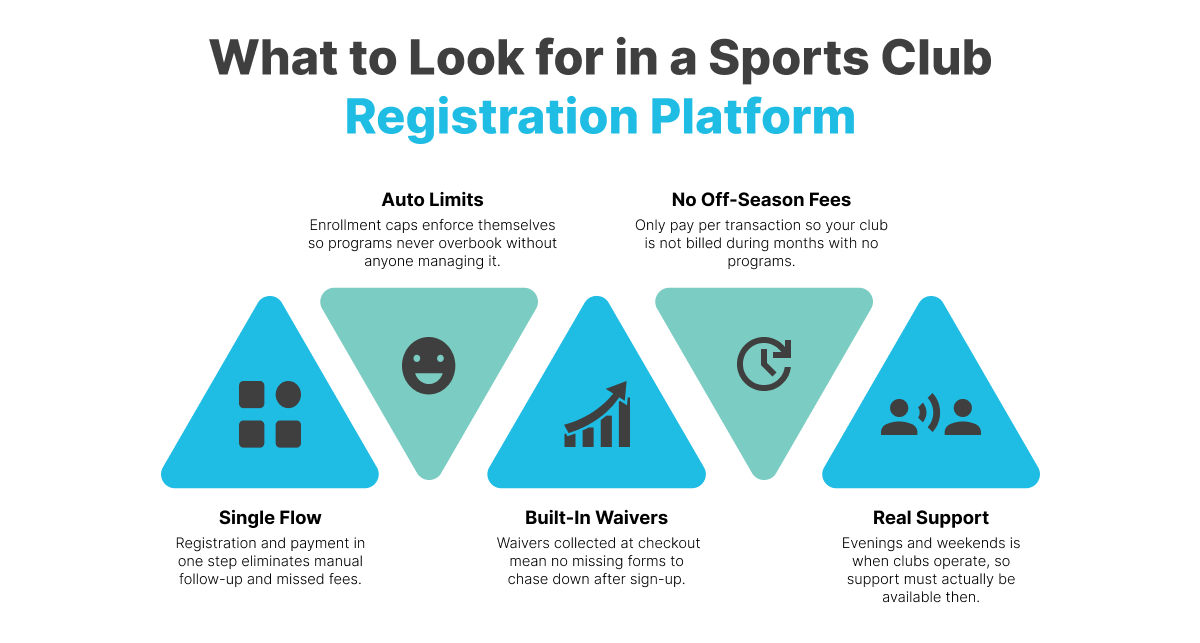 The Features That Actually Matter
Not every feature in a registration platform delivers the same value. Here are the ones that have the most impact on how a club actually operates day to day.
Registration and payment in a single flow. The biggest friction point in most club registration processes is the gap between signing up and paying. When families can do both in one step, conversion rates go up, payment collection becomes automatic, and the manual follow-up work disappears. Look for a platform where the checkout experience is clean, fast, and mobile-friendly. Most families will register on their phones. If the checkout is difficult on a small screen, you will lose registrations.
Enrollment limits with automatic cutoffs. If your programs have capacity limits, your platform should enforce them automatically. When a program is full, it should stop accepting registrations without anyone having to manually close it. This protects your programs from overbooking and creates the kind of real-time scarcity visibility that encourages families to register early. Checklick’s Storefront handles this automatically so administrators never have to manually manage program capacity.
Waiver forms built into the registration flow. Collecting waivers separately from registration is a common source of incomplete records. When the waiver is part of the checkout, every participant who registers has also agreed to the terms. There is nothing to chase down afterward.
Custom questions per program. Different programs need different information. A youth sailing camp might need to know about swimming ability. A martial arts program might need medical information. A summer camp might need dietary preferences. Your platform should let you add custom questions to specific programs, not just a single set of questions applied to everything.
Discounts and taxes. If your club offers early bird pricing, sibling discounts, or needs to configure taxes on certain products, your platform should handle this automatically. Manual discount processing creates errors and extra admin work. Checklick’s Storefront supports both opt-in and automatic discounts, as well as flexible tax configuration.
Branded receipts and confirmations. When a family completes a registration, they should receive a branded confirmation immediately. Not a generic system notification, but something that looks like it came from your club. This builds trust and reduces the questions that come in asking whether the registration went through. Checklick automatically emails branded PDF receipts to every customer the moment a transaction is complete.
Direct bank deposits. Your club’s revenue should go directly to your bank account, not sit in a third-party account that requires manual withdrawal. Look for a platform that deposits funds directly and gives you clear financial reporting.
Support that is actually available. Sports clubs do not operate on a nine-to-five schedule. Programs run on weekends. Registration questions come up on evenings. If your platform’s support is only reachable during business hours, you will be on your own when you need help most. Checklick offers phone and email support including weekends.
What to Watch Out For
Some platforms look like a good fit on paper but create new problems once you are using them.
Watch out for platforms that charge monthly fees regardless of whether your club is actively running programs. If your club has an off-season, you should not be paying for software during the months you are not using it. Checklick’s Storefront charges 4.9% per transaction with no monthly fees and no long-term commitment, so you only pay when your club is making sales.
Watch out for platforms that are not designed for sports clubs specifically. Generic e-commerce tools can handle payments, but they do not understand enrollment limits, waivers, program levels, or the specific needs of clubs running seasonal programs for youth athletes. A tool built for retail is not the same as a tool built for sports.
Watch out for platforms that require technical expertise to set up. If getting your storefront live requires help from a developer or weeks of configuration, that is time and money most clubs do not have. Checklick can have your storefront live within three days of getting started, and the setup is designed so that any club administrator can handle it.
Watch out for platforms where families have to create an account before they can register. Every extra step in the checkout process reduces completion rates. The easier it is for a family to go from deciding to register to actually completing the registration, the more of them will follow through.
How Real Clubs Have Made the Switch
Barrie Yacht Club had been using a system that required cheque payments, created difficult refund processes, and could not handle discounts reliably. After switching to Checklick’s Storefront, registration became cleaner and faster, refund issues were resolved, and the club was able to set up tiered sponsorship levels for external partners. They gained features they did not have before while eliminating the problems that had been slowing them down.
Gimli Yacht Club was managing registrations manually through email, with payments collected by cash or cheque often after programs had already started. After switching, they centralized everything through a single online entry point, required payment at the time of signup, and started saving an estimated 15 minutes per registration. With 80 participants annually, that adds up to roughly 20 volunteer hours saved every year.
West Hawk Lake Yacht Club moved from paper forms and cash handling to a fully digital registration system. Financial reporting became easier, instructors got real-time access to class lists, and the club presented a more professional image to participants.
These are not large organizations. They are community clubs that made a practical decision to find a better way to run their registration and payments, and the results were immediate.
A Simple Evaluation Framework
When you are comparing platforms, run each one through these questions.
Can a family register and pay in under five minutes on their phone? If the answer is no, the checkout experience will cost you registrations.
Does it handle enrollment limits, waivers, and custom questions without extra tools? If you need to piece together multiple systems to cover these basics, the platform is not built for clubs like yours.
Will it go live in a week or less without technical help? If setup takes months or requires outside expertise, the cost in time and money is already too high.
Does it cost anything during your off-season? If you are paying monthly fees when your programs are not running, that is money leaving your club for no return.
Is support available when your programs actually run? If the answer is only during business hours on weekdays, you are on your own for most of the season.
Checklick’s Storefront meets all of these criteria. Hundreds of sports clubs use it to manage registration and payments, and the setup is straightforward enough that clubs typically live within three days of getting started.
Start your 30-day free trial at checklick.com and see how it fits your club before making any commitment.
