

Running a sports club is complex. Running a national sports organization that oversees programs across hundreds of affiliated clubs is an entirely different order of challenge.
A national governing body does not just deliver programs. It sets the standards those programs must meet. It distributes its curriculum to coaches and training centers across the country. It collects evaluation data from thousands of participants to understand how those programs are performing. It updates its curriculum when evidence shows something needs to change. And it does all of this while maintaining the consistency that gives national certification programs their credibility.
The clubs that deliver the programs locally are doing their best with the resources they have. But without the right infrastructure connecting them to the national body, the information flowing between them is slow, inconsistent, and full of gaps. A national organization trying to understand program performance across hundreds of affiliated clubs by collecting spreadsheets and paper forms is not operating at national scale. It is operating at single-club scale, hundreds of times over, with all the inefficiency that implies.
This is the problem that the right platform solves. And it is the problem that organizations like Irish Sailing have recognized and are addressing through digital program management infrastructure.
The Scale Challenge That Most National Organizations Face
To understand why managing programs at national scale is so difficult, it helps to think through what is actually required.
A national governing body has a curriculum. That curriculum needs to reach coaches at every affiliated club. Those coaches need to be evaluating athletes against the same criteria so that a certification earned in one region means the same thing as a certification earned in another region. The evaluation data from all those coaches needs to flow back to the national body so it can assess program performance, report to funders, and make improvements based on evidence. And when the curriculum changes, those changes need to reach every club simultaneously so that all coaches are working from the current version.
With paper and spreadsheets, every stage of that chain involves manual steps. The curriculum is distributed as a document that clubs can interpret differently. Evaluations are recorded in whatever format each coach prefers. Data is submitted at the end of the season in whatever form the club has collected it. And curriculum updates are distributed through communications that some clubs action promptly and others do not get around to for months.
The result is a system that looks national from the outside but operates locally in practice. Each club is essentially doing its own version of the program rather than a consistent version of the national standard. And the national body has no reliable way to know the difference.
How Checklick Addresses This for National Organizations
Checklick was developed closely with Sail Canada specifically to address the challenge of managing national certification programs across affiliated clubs. It is a recognized platform within the Sail Canada program framework, which means the evaluation criteria built into the platform are aligned with national standards and the records it produces meet the compliance requirements that national certification programs operate under.
The Evaluation Marketplace is the feature that makes national-scale program delivery practical. National organizations build their skill checklists inside Checklick and make them available to affiliated clubs through the marketplace. Clubs license those checklists and their coaches use them to evaluate athletes. The evaluation data flows back to the national organization in real time. When the national body updates a checklist, the update is available to every licensed club immediately without anyone having to distribute a new document or retrain coaches on a new format.
This is what consistent national program delivery actually looks like when it is supported by the right infrastructure. The standards live in the platform, not in a document that gets interpreted differently by every club that receives it. Coaches at every club are evaluating athletes against exactly the same criteria. The data flows back to the national body without manual collection steps. And updates reach everyone simultaneously.
Irish Sailing appears in Checklick’s verified client network, reflecting the platform’s reach into national and international sailing organizations beyond Canada. The Evaluation Marketplace shows checklists available from Irish Sailing alongside those from Sail Canada and other recognized bodies, demonstrating that Checklick operates as a genuine national-level program management platform for governing bodies across multiple countries.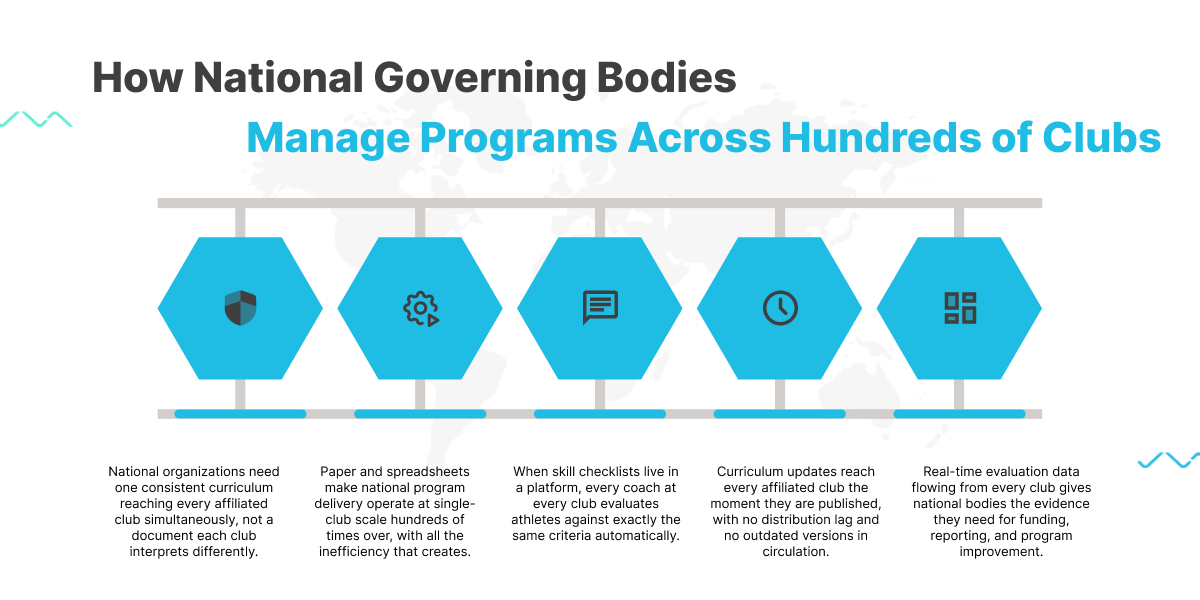
What This Means for Sub-Licensing and Regional Distribution
For national organizations with large affiliate networks, managing every individual club relationship centrally can become its own administrative burden. Checklick addresses this through sub-licensing, which allows regional partners to manage the re-licensing of national programs to clubs in their area.
This means a national governing body can establish its curriculum and standards centrally, work with regional bodies to distribute those standards to local clubs, and receive evaluation data from all of those clubs through the same centralized platform, without needing to manage every individual club relationship at the national level.
The program reaches more athletes. The administrative overhead does not grow proportionally. And the national body always has a current, accurate picture of how programs are performing across its entire network because the data flows automatically rather than depending on clubs submitting manual reports.
What Affiliated Clubs Get From This Arrangement
From the perspective of an affiliated club, participating in a national program through Checklick’s Evaluation Marketplace offers several concrete benefits that manual program delivery does not.
The curriculum is immediately accessible in a format that coaches can use on their phones during sessions rather than consulting a printed document between drills. Updates to the national curriculum reach the club automatically without the program director having to download a new version and redistribute it. The records coaches produce are automatically compliant with national standards rather than requiring a separate formatting or submission step. And the club can report its athlete development data to funders and governing bodies accurately because that data is centralized, consistent, and always current.
Starlight Sailing Adventures, a seasonal sailing school in British Columbia, experienced this directly. Before using Checklick, there was no central system for syncing Sail Canada certifications with participant tracking. After adopting Checklick, which is recognized as a Sail Canada platform, the school was able to manage evaluations and certifications in one place, eliminate spreadsheets and paperwork, and give instructors real-time access to class rosters. Records became centralized, audit trails were supported automatically, and the school achieved compliance with Sail Canada standards without any additional manual effort. The outcome was a stronger professional presence, a scalable system for future growth, and fully digital certifications across all programming. Read Starlight Sailing’s full story here.
This is the experience that national program delivery through Checklick produces at the club level. Not just a simpler administrative process, but a more professional, more compliant, and more scalable operation.
The Data Advantage for National Organizations
One of the most powerful outcomes of managing national programs through a connected platform is the quality of the data that the national body receives.
When evaluation data flows in real time from every affiliated club rather than arriving in batches at the end of the season, national organizations always have a current picture of program performance. They can see aggregate participation numbers, skill completion rates, and progression data across their entire network without waiting for clubs to submit annual reports.
This data is useful in multiple ways. It helps national bodies identify where programs are working well and where they need improvement. It provides the evidence base for curriculum updates. It supports funding applications and reporting requirements for national sports funding bodies. And it demonstrates program impact in a way that anecdotal evidence from individual clubs never can.
For a national governing body that is accountable to its members, its funders, and its sport, that data capacity is not a nice-to-have. It is what makes the organization credible and effective at a national scale.
Getting a National Program Infrastructure in Place
For national organizations that are still managing affiliate program delivery through documents and manual data collection, the path to a better system starts with the Evaluation Marketplace.
Building national skill checklists in Checklick and making them available to affiliated clubs through the marketplace is the foundation. Once that is in place, clubs can license the checklists, coaches can start evaluating athletes using them, and data starts flowing back to the national organization immediately.
Checklick can have a basic program infrastructure live within three days of getting started. Phone and email support is available including weekends, which matters when clubs across different time zones and different seasons are running programs simultaneously.
If your national organization or governing body is still managing program delivery through manual distribution and collection, the gap between your current operations and what a connected platform makes possible is larger than it might appear. The data you are missing, the consistency you are unable to enforce, and the administrative burden you are carrying every season are all solvable problems.
Learn more and request a consultation at checklick.com.
