

Something shifts in a country when it hosts the world’s biggest sporting event. The games are on every screen. The conversations are happening at every dinner table. Kids who had never thought much about soccer are suddenly watching it every evening, wearing their country’s colors, and asking questions about how the game works.
That shift is happening in Canada right now. The FIFA World Cup 2026 is being co-hosted across Canada, the United States, and Mexico, with thirteen matches played on Canadian soil in Toronto and Vancouver. For a country where soccer is already the most played youth sport, the cultural impact of hosting the tournament is significant. For sports clubs that run youth soccer programs, it represents one of the most meaningful opportunities in years to grow enrollment, retain new participants, and build programs that last well beyond the final whistle.
This blog is not about the tournament itself. It is about what happens in communities around it, and what sports clubs can do to make the most of the interest it generates. If you want to read more about setting up your club’s registration before the season ends, start with our guide on how to sell out your summer sports program before the season opens
Why World Cup Moments Matter for Youth Sport Participation
Major international tournaments consistently produce measurable increases in youth participation in the sports they feature. When a country hosts a tournament, that effect is amplified because the emotional connection to the games is stronger. Children are not just watching a sport. They are watching their country, their cities, their flag.
Canada Soccer has recognized this with the launch of Club+, a multi-year initiative designed to help clubs convert World Cup momentum into lasting grassroots participation. The Government of Canada has invested in programs aimed at growing youth sport participation nationally, including building community soccer pitches as part of the tournament’s long-term legacy. These investments signal something important: the opportunity the World Cup creates for youth sports is not expected to last only through July 19. It is being treated as the beginning of a multi-year participation surge.
For youth soccer clubs, this is the context. Families who have been watching the tournament with their children are thinking about soccer in a way they were not three months ago. Children who have never kicked a ball are asking to try it. Families who had their children enrolled in other sports are considering a switch. The interest is real, it is elevated, and it is happening right now.
What Clubs That Capture This Moment Look Like
The clubs that benefit most from a participation surge like this are not necessarily the ones with the best facilities or the most experienced coaches. They are the ones where joining is easy, where registration is open, and where the first experience a new family has with the club is professional and friction-free.
When a family decides to enroll their child in a soccer program, the decision window is often short. They think of it in the moment, go looking for a club online, find a registration page, and either complete the process right then or put it aside and forget about it. The clubs that capture those families are the ones whose registration page works cleanly on a phone, where the checkout takes minutes rather than days, and where a confirmation arrives immediately so the family knows their spot is secured.
The clubs that lose those families are the ones where registration requires sending an email and waiting for a reply, where payment is collected separately from the registration form, and where the process has enough friction that a family looking to sign up in the evening ends up deciding to think about it more and then never following up.
Port Dover Yacht Club understood this when they launched a new two-week sailing program using Checklick’s Storefront. The outcome was a program that sold out and saw high demand. Families and staff found the process easier and more manageable than what the club had used before. Registration became faster and more streamlined. The program launched successfully because the infrastructure to capture interest was in place before the interest arrived. Read the Port Dover Yacht Club success story
That same principle applies directly to youth soccer clubs in Canada right now. The interest is arriving. The question is whether your registration infrastructure is ready to capture it.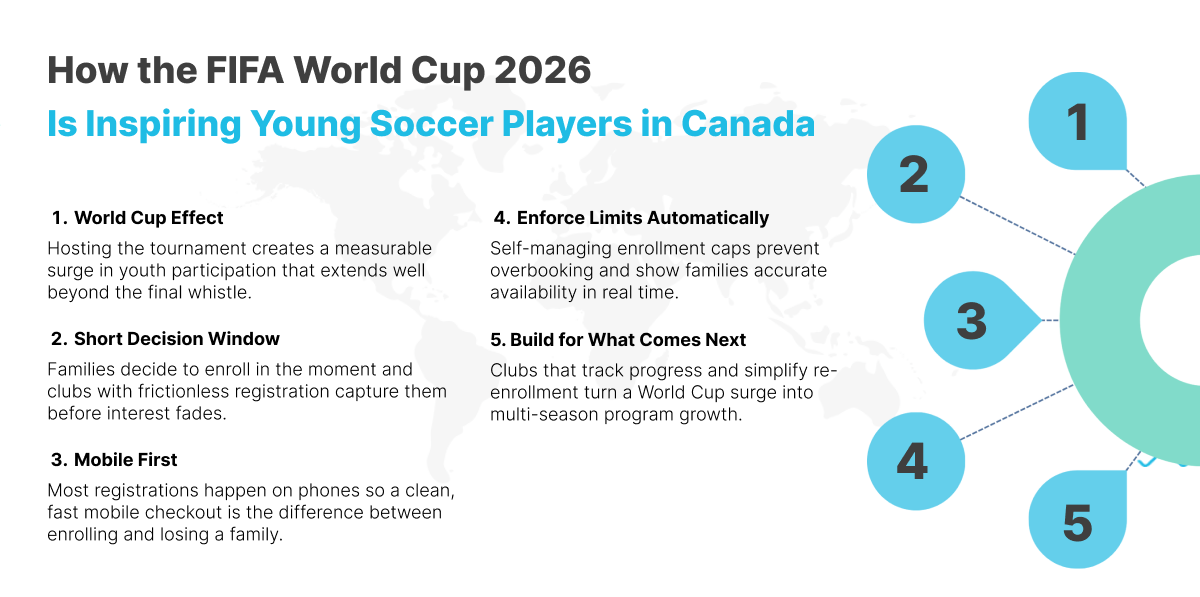
What the Registration Experience Needs to Look Like
For a youth soccer club trying to capture World Cup-driven interest in July 2026, there are four specific things the registration experience needs to do well.
The first is mobile optimization. The majority of people who look up a sports club and decide to register will do so on their phone. If your registration page does not load cleanly on a mobile screen, requires zooming in to read, or has a checkout flow that was designed for a desktop browser, you will lose a significant portion of the families who were genuinely interested. Checklick’s Storefront is built mobile-first so families can complete the full registration and payment process on any device without friction. See how Checklick’s Storefront works
The second is a single-step checkout. Registration and payment need to happen together. When a family can select a program, fill in their details, and pay by credit card in one uninterrupted flow, they complete the process. When registration and payment are two separate steps with anything in between them, a meaningful percentage of families complete the first step but never follow through on the second. The gap between expressing interest and becoming a paid participant has to be as small as possible.
The third is automatic confirmation. The moment a family completes their registration, they need to receive a confirmation that tells them their spot is secured. Without that confirmation, families are left uncertain about whether their registration actually went through, which leads to follow-up emails, duplicate registrations, and unnecessary administrative work for club staff. Checklick’s Storefront sends a branded PDF receipt the moment a transaction is complete so families have immediate proof of their enrollment.
The fourth is enrollment limits that enforce themselves. Summer soccer programs have capacity constraints based on coach ratios, field availability, and equipment. When enrollment limits are set in the system and enforced automatically, programs close when they fill without anyone having to monitor signups manually. Families who arrive after a program is full see that clearly and can choose an alternative session rather than registering for something that is already overbooked. This prevents the operational chaos of oversold programs and gives families accurate information at every point in the process.
Building for the Wave That Comes After the Tournament
The FIFA World Cup 2026 final is scheduled for July 19. The elevated interest in youth soccer that the tournament creates will not end on July 20. It will continue into the fall registration season as families look for programs for their children to continue in. It will show up in next summer’s program demand as families who tried soccer this year want to return. And it will compound over the years ahead as Canada builds toward the LA28 Olympics and the FIFA Women’s World Cup 2031.
Youth soccer clubs that treat the World Cup as a short-term promotional window will capture some of the immediate demand. Youth soccer clubs that treat it as the beginning of a multi-year growth opportunity and build the operational infrastructure to sustain and develop new participants over multiple seasons will gain something much more valuable.
That longer-term thinking requires more than a working registration page. It requires athlete development tracking that shows parents how their children are progressing through the program. It requires communication that keeps families connected to what is happening throughout the season. It requires a system that makes re-enrollment at the end of the season feel like a natural next step rather than starting the decision process from scratch. See how Checklick’s athlete development tracking works
Checklick is an all-in-one Athlete Development Tracking System and Sports Club Management System used by hundreds of sports clubs across Canada and Ireland to manage registrations, track athlete development, and keep parents and coaches connected. It is rated 4.7 on GetApp and Software Advice based on verified user reviews.
The Storefront charges 4.9% per transaction with no monthly fees and no long-term commitment. Start your 30-day free trial
Frequently Asked Questions
What is the best way for a youth soccer club to capture World Cup interest in 2026?
The most effective approach is having online registration open and easily accessible on mobile devices so families who decide to enroll can complete the process immediately. Enrollment limits, automatic confirmation, and a single-step checkout all reduce the gap between interest and registration.
How does a sports club handle a sudden surge in enrollment demand?
A platform that enforces enrollment limits automatically is essential. When programs close when they fill, the club avoids overbooking and families get accurate availability information in real time. Checklick’s Storefront manages this automatically without any manual monitoring required.
Does the FIFA World Cup 2026 create long-term growth for Canadian youth soccer clubs?
Yes. Canada is co-hosting the tournament, and Canada Soccer has launched multi-year initiatives to convert tournament momentum into lasting grassroots participation. The surge in interest is expected to continue into fall programs, next summer’s enrollment, and the years ahead leading toward the LA28 Olympics.
